Summary: The Grinder at our Green Recycling Center is the first step in turning Sonoma County’s yard debris into mulch, bark, and compost. Here is how it works, and why grinding first collapses composting time from years to months.
If you’ve ever watched a customer stop at our Green Recycling Center mid-sentence, mouth open, staring across the yard, chances are the Grinder is running. It’s hard not to gawk. While controlling the grinder remotely from his cabin, a wheel loader feeds scoop after scoop of branches, brush, and logs into one end of this diesel-powered beast. Scoop after scoop of branches, brush, and logs into one end of this diesel-powered beast, and out the other end comes something else entirely: a steady stream of small, chewed-up organic fragments, ready to become mulch, walk-on bark, or the first stage of compost. The horizontal Grinder is the machine that turns “yard debris” into raw material, and it does it with the kind of unapologetic horsepower that makes people actually put their phones down and watch.

Real Horsepower, Real Purpose: Diverting Yard Debris From the Landfill
That power isn’t for show. Picture swinging an axe into a tree trunk, then doing it hundreds of times a second – that’s roughly the job the cutting drum is built for. It matters more than the spectacle suggests, too. Much of what feeds this machine would otherwise be headed to a landfill: cleanup material from homeowners, landscapers, and tree-service crews, plus debris cleared for wildfire prevention along roadways and greenbelts. Organic material was never meant to be buried and sealed away to rot anaerobically (without oxygen) – it’s meant to be recycled, and the Grinder is where that recycling starts.
Inside a Horizontal Grinder: How Branches Become Mulch, Bark, and Compost Feedstock

Inside, it’s more precise than the name “grinder” lets on. Raw material lands on a feed table, which doses it onto an infeed wheel – a second drum that rides up and down to keep a steady thickness moving into the mill. Pressure and torque sensors watch the flow, adjusting as the mill’s cutting teeth do the work. Underneath sit two screen grates, sized differently, catching anything not small enough and sending it back through — a welded baffle plate essentially tells oversized chunks, “not yet, try again.” Only once material passes through does it drop onto the discharge belt. Heavier carbon, such as branches four inches and up and logs, heads for the bark pile; lighter carbon, such as leaves and hedge trimmings, heads for compost.
The Magic of Composting — and How the Grinder Speeds It Up
Compost is where the real magic shows up. What comes off of the grinder is typically sized ten millimeters and smaller – small enough that decomposition has much more surface area to work with, but not so fine that it loses the texture compost needs for water absorption and soil aeration. Here’s the part that never stops being a little wondrous: it genuinely does not matter whether that feed pile started as a rhododendron farm, a hedge of azaleas, or a tangle of blackberries. Air, moisture, and carbon go in; bacteria do the heavy lifting; heat and decomposition follow. By the time it’s finished cooking and curing, it all converges into essentially the same nutrient-rich material. Different sources, same beautiful outcome- that’s the trick composting pulls off every single time.
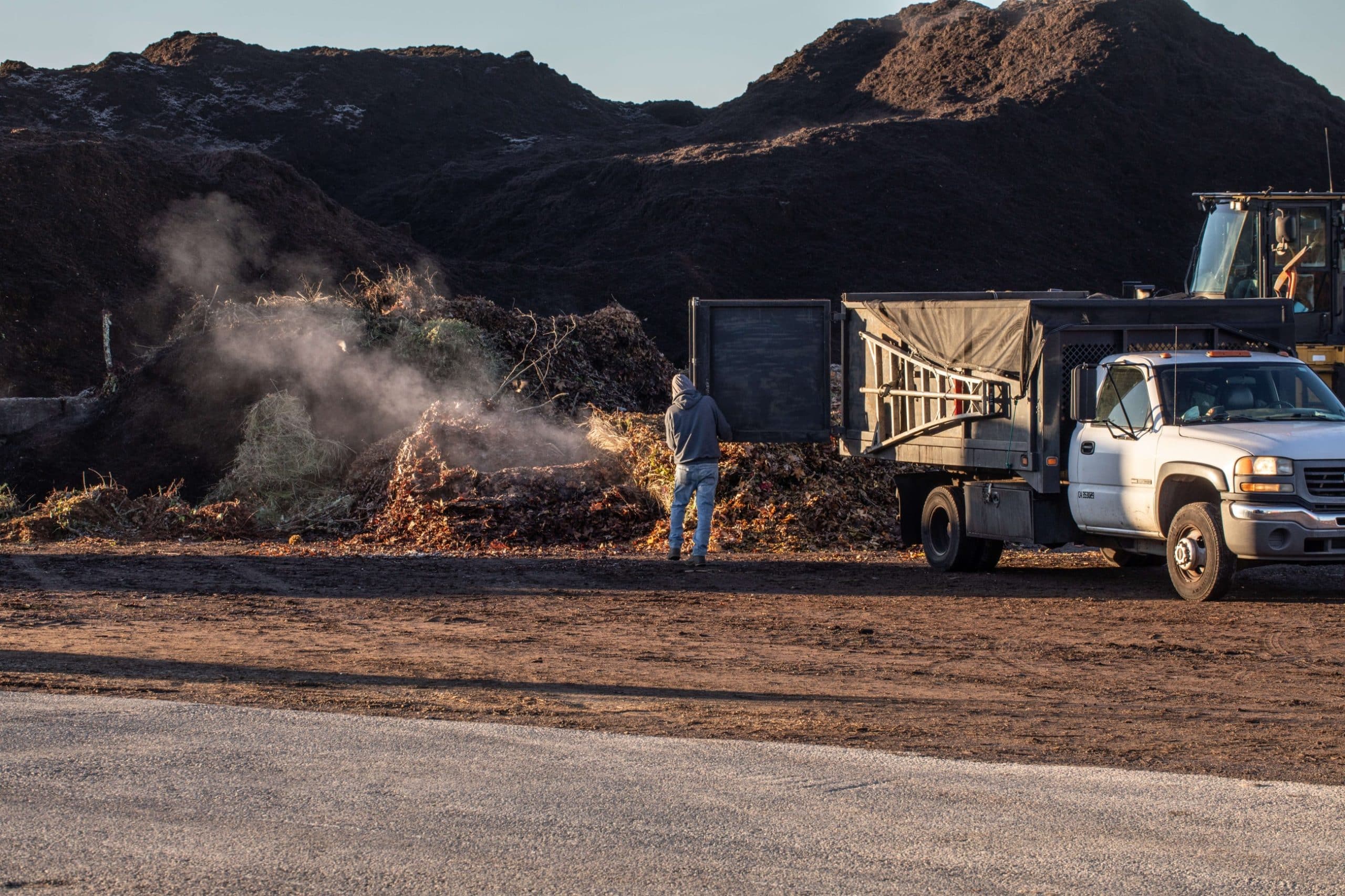
What the Grinder really contributes to that trick is time, or rather, the compression of it. Left alone, a pile of branches and logs can take years to break down naturally; even the smaller stuff needs months. Run it through the Grinder first, and that timeline collapses dramatically, because smaller particles simply have more surface exposed to the air, moisture, and microbes that do the converting. It’s not manufacturing anything Mother Nature wasn’t already going to do; it’s just doing it at a pace that fits a production yard instead of a forest floor. Call it a composting accelerator, or if you’re feeling generous, a bit of a time machine for organic matter.
Why “Grinder” Doesn’t Do This Machine Justice
Which brings us to the name. “Grinder” honestly undersells this machine. Americans have a habit of shrinking big things into small words — bicycle becomes bike, automobile becomes car — and somewhere along the way, “reduces organic waste into the raw material of new soil” got shortened to “grinder,” a word that mostly makes people think of overwork, or something grating on their last nerve. Neither fits a machine whose entire job is turning yesterday’s yard debris into tomorrow’s soil. We haven’t landed on a better name yet — pulverizer and macerator were both floated, neither stuck — so for now, the Grinder keeps its undersized name, its oversized job, and our utmost appreciation for what it does.