Summary: A zone-by-zone guide to building defensible space in Sonoma County, using the Resilient Landscapes Coalition’s three-zone framework: non-combustible stone and aggregate closest to the home, composted mulch inside well-spaced planting islands through Zone 1, and Arbor Mulch pathways farther out.
Fire season has a way of reordering priorities. The weeds you’d been meaning to pull, the mulch that’s a little too close to the porch, the dry brush along the fence line — suddenly none of it can wait. If you’ve spent the last few weeks doing exactly this kind of work around your own home, you’re in good company. Our team members are right there with you, because we live in Sonoma County too. We raise our families here, we drive these same roads past the same hillsides, and when fire season arrives, we’re just as focused on protecting our own homes as you are protecting yours.
The clearest guidance on how to do that comes from the Resilient Landscapes Coalition, a Sonoma County partnership between FireSafe Sonoma, the Sonoma Ecology Center, the Habitat Corridor Project, and the UC Master Gardener Program. Their defensible space framework breaks a property into three zones radiating out from the home. Here’s how our materials fit into that plan.
What is defensible space, and why does it come in zones?
Defensible space is the area around your home designed and maintained to increase the odds for the structure to survive a wildfire. The Resilient Landscapes Coalition divides that area into three zones, each with its own rules for planting, mulch, and hardscape:
- Zone 0, the Ember-Resistant Zone: 0–5 feet from the house
- Zone 1, the Home Protection Zone: 5–30 feet from the house
- Zone 2, the Reduced Fuel / Thinning Zone: 30–100 feet from the house
What materials belong in the first 5 feet around your house (Zone 0)?

Zone-0 landscape materials for the first five feet, Sonoma County, California; Photo by Saxton Holt, Landscape by April Owens Design
The first five feet around your home, including the structure itself, matters most. Research from the Insurance Institute for Business and Home Safety points to this narrow ring as having the greatest impact on whether a home survives a wildfire, since windblown embers landing near the foundation cause most home losses.
- No organic mulch or wood chips within 5 feet of the house
- No vegetation directly against the structure
- Use gravel, crushed rock, pavers, or concrete instead
- Soiland decorative stone and aggregate are built for this zone
- New decorative stone and paver options are arriving at Yard & Garden this year
What’s the best mulch for fire-resistant landscaping 5–30 feet from your home (Zone 1)?
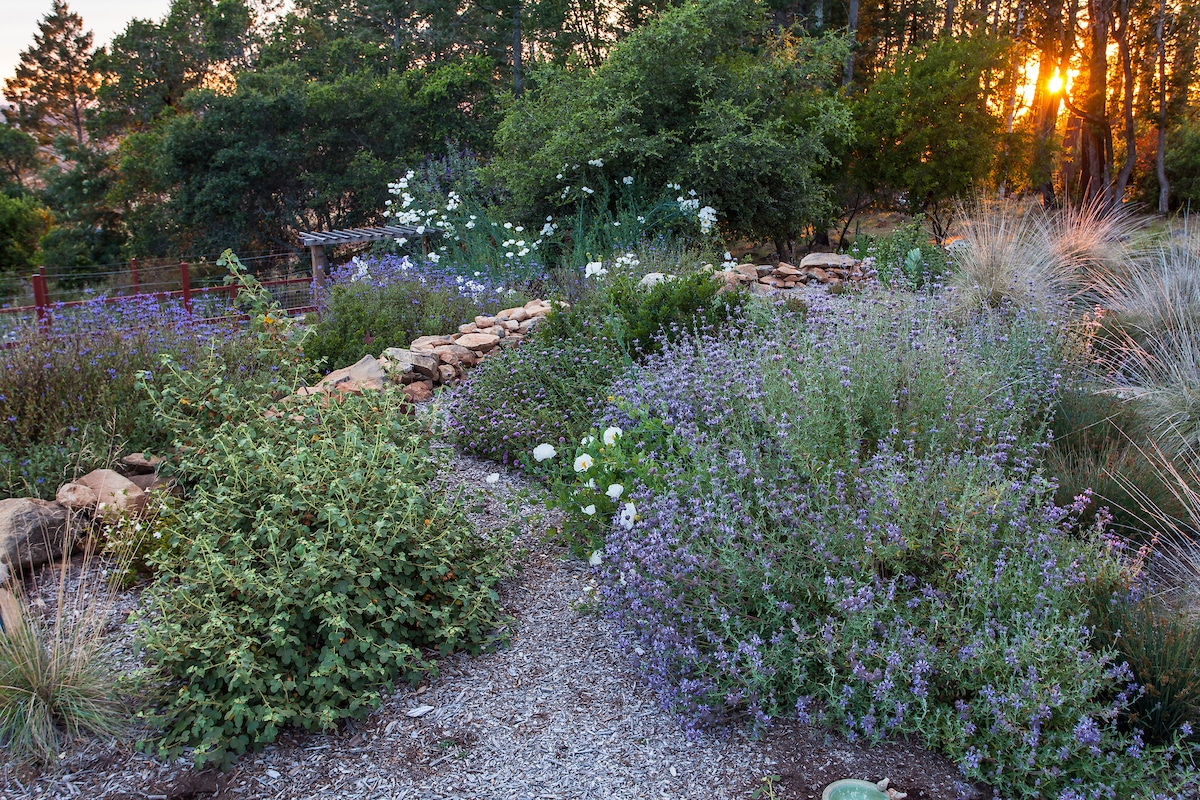
California native plants in island beds for discontinuous vegetation fire safety in firewise garden, Sonoma County, California; Photo by Saxton Holt, Landscape by April Owens Design
Past five feet, the goal shifts from “nothing combustible” to “landscaping that won’t carry fire to your house.” The coalition recommends grouping plants into “islands,” spaced apart by non-combustible breaks, with mulch used only inside those islands.
- Plant in islands, separated by hardscape, pathways, or well-hydrated groundcover
- Space islands roughly twice the height of the plants they contain
- Use 2–3 inches of composted wood-chip mulch inside planting islands
- Clean Green compost and Arbor Mulch suppress weeds, hold soil moisture, and cut irrigation needs
- Avoid finely shredded mulch like gorilla hair — it’s called out by name as highly ignitable and prone to blowing while burning
Can you use mulch farther from the house, in zone 2?
Thirty to 100 feet out, the goal shifts again, from hardening to thinning.
- Wood mulch is allowed more freely in this zone
- Arbor Mulch is an acceptable pathway material between plant groupings here
- The focus is reducing continuous fuel while preserving habitat and screening
How is Soiland materials involved with Sonoma County’s Firewise community?
Last year, we supplied Clean Green and Arbor Mulch for an interactive Firewise demonstration garden at the Sonoma County Fairgrounds, built in partnership with the Resilient Landscapes Coalition. Seeing those materials used in a real, walkable garden, with zone-by-zone examples of what belongs where, made the abstract guidance feel a lot more concrete. It is the kind of local collaboration we want to keep showing up for, because fire-hardening a community only works when homeowners, landscapers, and suppliers are all pulling in the same direction.
Where can you get Firewise landscaping materials in Sonoma County?
Think of your property in layers: non-combustible stone and aggregate hard against the house in Zone 0, Clean Green and Arbor Mulch inside well-spaced planting islands through Zone 1, and a lighter touch of mulch and native plantings out through Zone 2. For full detail on plant selection, spacing, and maintenance by zone, the Resilient Landscapes Coalition’s website is the resource we point people to.
We’ll keep sourcing these materials locally, keep testing them for quality, and keep showing up at events like the fairgrounds garden, because this is our county too, and we’re doing the same work in our own yards that you’re doing in yours.